Government to Introduce Major Insolvency Reforms in March 2026
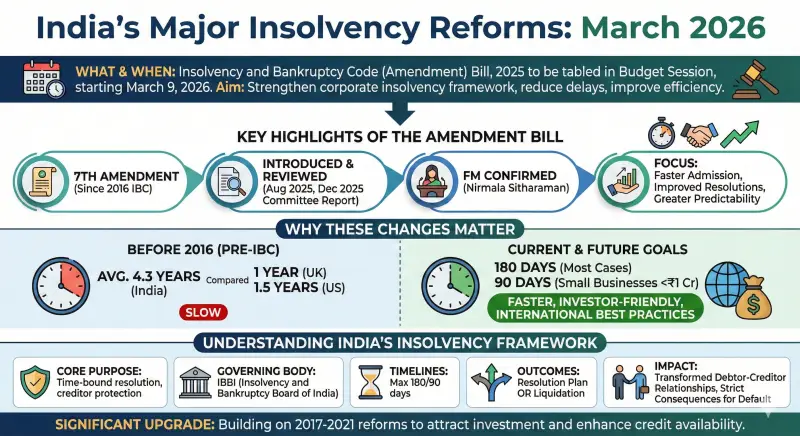
The Indian government will table the Insolvency and Bankruptcy Code (Amendment) Bill, 2025 during the second half of the Budget Session starting March 9, 2026. This crucial legislation aims to strengthen India's corporate insolvency framework by reducing delays and improving efficiency in resolution processes.
Key Highlights of the Amendment Bill
- This will be the seventh amendment to the landmark Insolvency and Bankruptcy Code originally enacted in 2016
- The Bill was first introduced in Lok Sabha on August 12, 2025 and referred to a parliamentary committee for review
- After incorporating suggestions from the select committee's December 2025 report, the government is now ready to table the revised version
- Finance Minister Nirmala Sitharaman, who also oversees Corporate Affairs, confirmed the Bill is ready for introduction
- The amendments focus on faster admission of cases, improved resolution outcomes, and greater predictability for creditors and investors
Why These Changes Matter
Before the IBC's introduction in 2016, resolving insolvency cases in India took an average of 4.3 years – significantly longer than the 1 year in the UK or 1.5 years in the US. The current framework mandates resolution within 180 days (extendable only with creditor approval), while smaller businesses and startups with turnover under ₹1 crore must complete the process within 90 days.
The upcoming amendments aim to bring India's insolvency regime closer to international best practices, creating a more investor-friendly environment. By addressing procedural bottlenecks and strengthening creditor rights, these changes should enhance credit availability while maintaining balance between debtor and creditor interests.
Understanding India's Insolvency Framework
- Core Purpose: To provide a time-bound process for resolving corporate distress while protecting creditor interests
- Governing Body: Insolvency and Bankruptcy Board of India (IBBI) oversees implementation
- Resolution Timeline: 180 days maximum for most cases (90 days for small businesses)
- Possible Outcomes: Either a resolution plan approved by creditors or liquidation of assets
- Impact: The IBC has fundamentally transformed debtor-creditor relationships in India by introducing strict consequences for default
This amendment represents the most significant upgrade to India's insolvency framework in a decade, building on previous reforms from 2017-2021. By streamlining procedures and reducing delays, the government aims to strengthen India's position as an attractive destination for domestic and foreign investment.